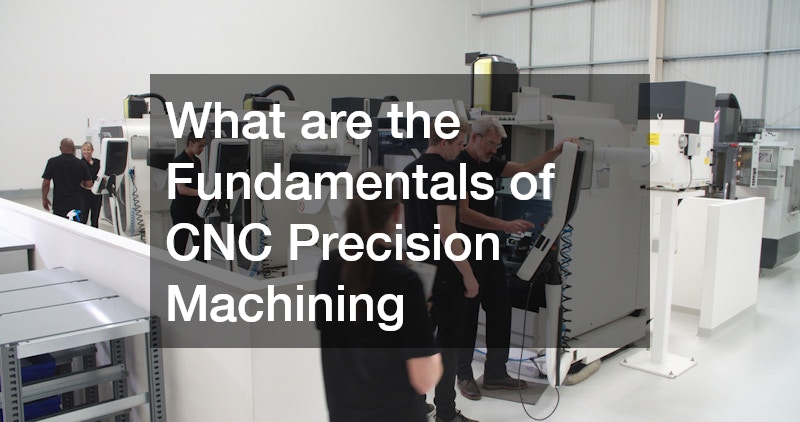

CNC precision machining is a manufacturing process that uses computer-controlled machines to produce highly accurate and repeatable parts. It plays a critical role in industries where tight tolerances, consistency, and reliability are essential. By translating digital designs into physical components, CNC machining removes much of the variability associated with manual manufacturing methods.
At its core, this process relies on automated controls, programmed toolpaths, and advanced machinery to shape raw materials into finished parts. Metals, plastics, and composites can all be machined with exceptional accuracy when the fundamentals are properly applied.
How CNC Precision Machining Works
CNC machines operate based on instructions generated from computer-aided design files. These instructions guide cutting tools, spindles, and movement axes to shape material with extreme precision.
Digital Design and Programming
Every CNC machining project begins with a digital model. Engineers use CAD software to design parts down to exact dimensions. This model is then converted into machine-readable code using CAM software. The resulting program dictates tool movement, cutting depth, speed, and sequence.
Precision at this stage is critical. Any error in programming can be repeated across every part produced, which is why careful verification and simulation are standard practice in cnc precision machining workflows.
Automated Material Removal
Once the program is loaded, the CNC machine removes material from a workpiece using cutting tools such as end mills, drills, or lathes. The machine follows the programmed path exactly, allowing it to create complex geometries that would be difficult or impossible to achieve by hand.
Because the process is automated, the same part can be produced repeatedly with minimal variation, making CNC machining ideal for both prototyping and production runs.
Core Components of CNC Precision Machining
Several key elements work together to ensure accuracy and consistency throughout the machining process.
CNC Machines and Axes
CNC machines are available in various configurations, including mills, lathes, and multi-axis machining centers. The number of axes determines how many directions a tool or workpiece can move. More axes allow for greater complexity and fewer setups, improving accuracy and efficiency.
Multi-axis machines are especially valuable in cnc precision machining applications that require tight tolerances or intricate designs.
Cutting Tools and Tool Holders
The quality of cutting tools has a direct impact on surface finish and dimensional accuracy. Tool material, geometry, and coating must be matched to the workpiece material and machining conditions.
Proper tool holding is equally important. Secure, vibration-free tool holders help maintain precision and reduce wear, ensuring consistent results over long production cycles.
Materials Used in CNC Precision Machining
Material selection influences everything from cutting speeds to tool life and final part performance.
Common Machined Materials
Metals such as aluminum, steel, stainless steel, brass, and titanium are widely used due to their strength and durability. Plastics like ABS, nylon, and PEEK are also common when lightweight or corrosion-resistant parts are needed.
Each material responds differently to machining forces, which requires adjustments in tooling and programming to maintain precision.
Material Properties and Tolerances
Hardness, thermal expansion, and machinability all affect achievable tolerances. In cnc precision machining, understanding how a material behaves under cutting conditions helps manufacturers maintain tight dimensional control and prevent distortion.
Accuracy, Tolerances, and Quality Control
Precision machining is defined by its ability to meet exact specifications consistently.
Dimensional Accuracy
Tolerances in CNC machining can reach extremely tight limits, often measured in thousandths of an inch or microns. Achieving this level of accuracy depends on machine calibration, tool condition, and stable machining environments.
Even small temperature changes can affect measurements, which is why controlled shop conditions are common in high-precision operations.
Inspection and Verification
Quality control is integrated throughout the machining process. Measuring tools such as calipers, micrometers, and coordinate measuring machines are used to verify part dimensions.
In cnc precision machining, inspection ensures that every part meets design requirements before moving to the next stage of production or delivery.
Advantages of CNC Precision Machining
This manufacturing method offers several benefits that make it indispensable across industries.
Consistency and Repeatability
Once a program is perfected, CNC machines can produce identical parts repeatedly with minimal variation. This consistency is essential for aerospace, medical, and automotive applications where reliability is critical.
Efficiency and Scalability
Automation reduces manual labor and speeds up production. CNC machining can scale from single prototypes to large production volumes without sacrificing accuracy, making it a flexible solution for manufacturers.
Applications Across Industries
CNC precision machining supports a wide range of sectors, from electronics and defense to healthcare and energy. Components such as brackets, housings, shafts, and complex mechanical parts rely on precise machining to function correctly.
As technology advances, the demand for higher accuracy and more complex parts continues to grow, reinforcing the importance of mastering the fundamentals of this process.
By understanding the machines, materials, programming, and quality controls involved, manufacturers can fully leverage cnc precision machining to produce reliable, high-quality components for demanding applications.
Related Posts

PA System Installation Tips
Getting the PA system installation wrong can lead to various issues. These issues can negatively impact the performance of the…

Why Every Business Needs Tailored Cybersecurity Solutions in Today’s Digital Landscape
Why Every Business Needs Tailored Cybersecurity Solutions in Today’s Digital Landscape In the rapidly evolving digital landscape, businesses face unprecedented…

Your Guide to Home Improvement Service Company Website Design
Creating a compelling and effective website for a home improvement service company involves a myriad of considerations. The right website…